Empowering aged-care home citizens through custom furniture prioritising user-centred design, sustainability, and social context factors.
FLEXIFURNITURE
Design Brief: To utilise 3D printing and sustainable materials to create custom aged care furniture suited to the user group's needs.
Product Overview: This project was created during my time as a vacation researcher. The project was conducted as part of a wider project called “Floor to Form”. Overall, the project focuses on creating 3D-printed modular furniture that can be modified depending on the situation to increase the autonomy of residents.
Year : 2021
DISCOVER & DEFINE
RESEARCH

The focus of this project was utilising 3D printing to better cater for the ergonomics and needs of aged care residents. Therefore both primary and secondary research was undertaken. Primary research included site visits to Healthcraft, Balgotex furniture and Armhub. The major research findings are listed below.
-
Aged-care citizens face health issues (incontinence, mobility, communication) while residing in care homes. Existing furniture in these homes fails to cater to both health needs and the activities residents do each day (socialise, eat, exercise etc.). This increases the workload of care staff and decreases the autonomy of residents, limiting their ability to engage in new activities and perform basic tasks independently.
-
Currently, in Australia, furniture waste amounts to 30’000 tonnes annually. This is because furniture is often made from non-biodegradable materials and once a single part is damaged, the piece of furniture is thrown away. Further, due to the bulky nature of furniture, it can be difficult to transport. This means that an increased number of transport vehicles are needed, adding to increased carbon emissions.
-
3D printing can be utilised to create custom parts. Depending on the size and orientation of the object, the plate may allow it to be printed in one go. To increase the overall sustainability of a product, recycled filaments can be used. This can include bio-composites that can utilise recycled materials like sawdust and bamboo to act as fillers.
DESIGN CRITERIA
Based on research, various criteria were set to create a product that satisfied the users needs.
-
Based on different use scenarios including eating, interacting with other residents and entertainment time, the furniture must be modular and be able to suit different room settings.
-
Due to things like urinary incontinence and food spillages, the fabric must be waterproof and be able to be cleaned easily.
-
The materials used and manufacturing processes must be sustainable. This can include modular 3D printed furniture using sustainable materials.
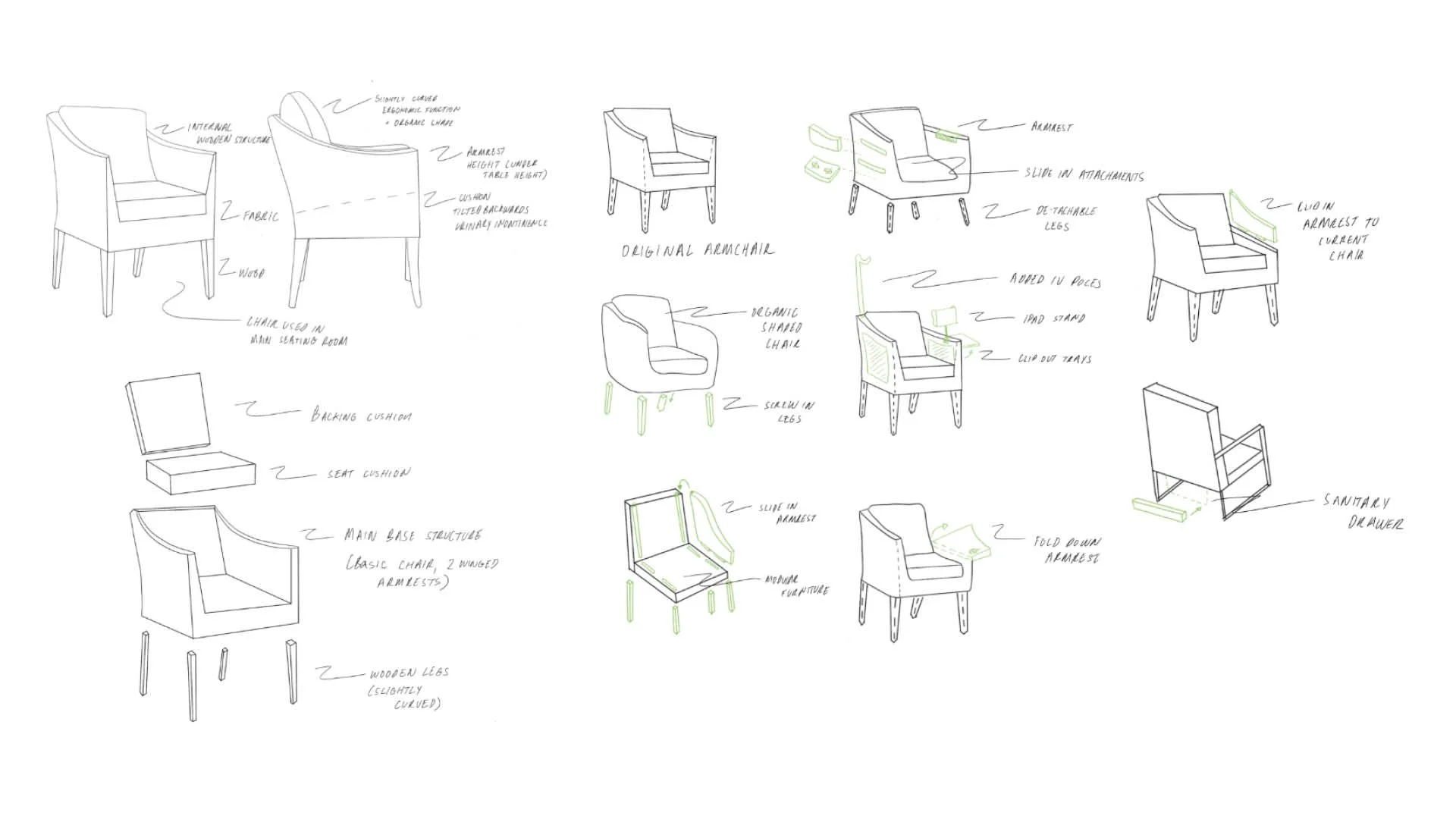
A series of sketches and low-fidelity modelling was utilised to ideate the basic form of the furniture.
DEVELOP
-
![]()
SKETCHING CHAIR ATTACHMENTS
Initial sketches were made to analyse the key components of the chair and potential iterations for new designs. Sketches included new chair attachments and layouts.
-
![]()
SKETCHING & PROTOTYPING : JOINT TESTS
Low-fidelity prototyping utilising cardboard was used to experiment with different joint iterations.

DELIVER
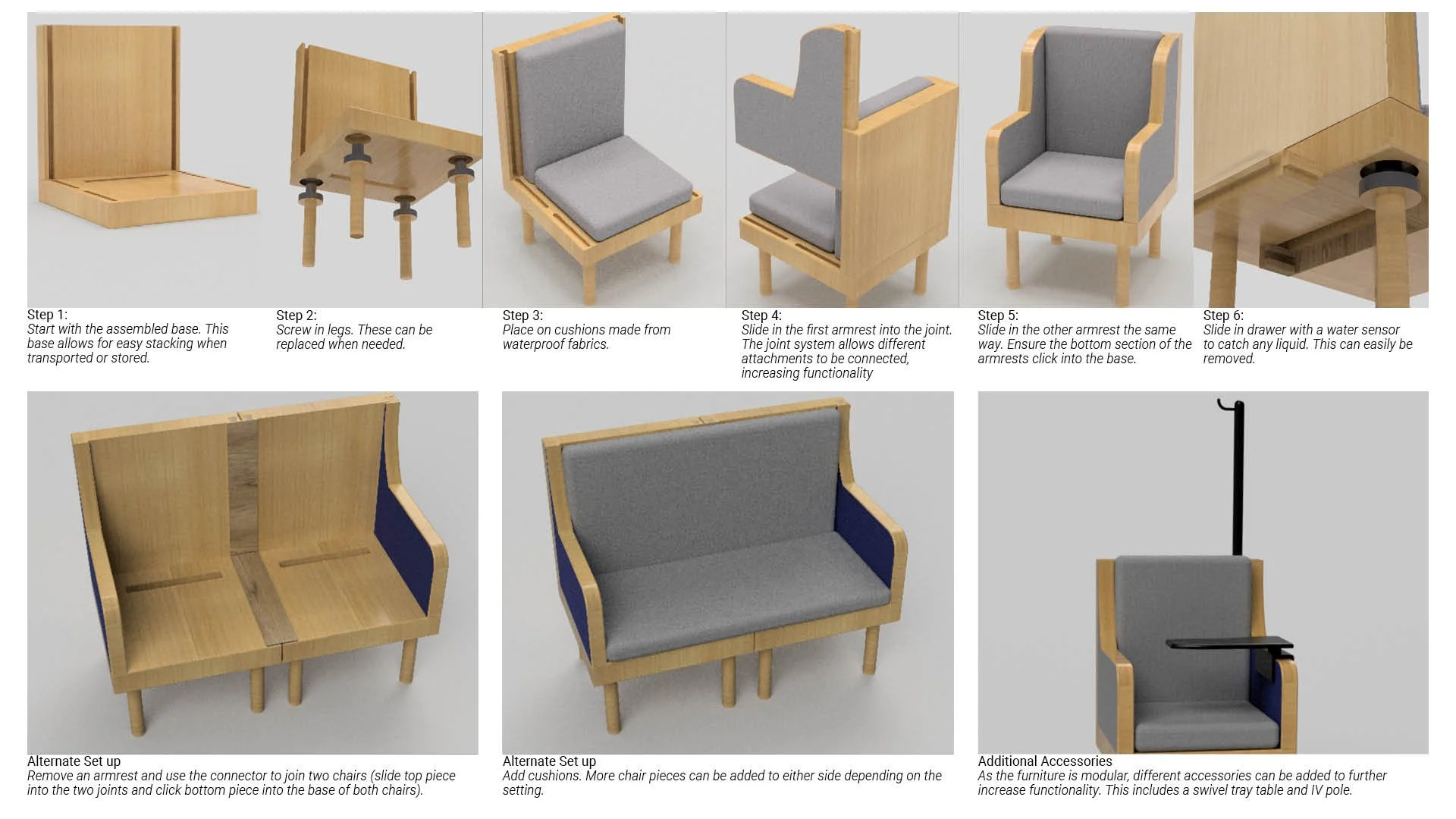
FLEXIFURNITURE was designed to address the challenges above by prioritising accessibility and modularity. It allows for wheelchair access by removing armrests, enables connection of chairs, and supports attachments like IV poles and tray tables. The chair design includes a slight backward tilt and assistive technology including a water sensor to accommodate incontinence. By expanding the range of activities, FLEXIFURNITURE promotes resident decision-making, an active lifestyle, and improved mental health by increasing socialisation. It also alleviates the burden on care workers, enhancing productivity and personalised care for residents.
Below shows a prototype of chair joints, assistive technology and a CAD assembly.
CONTEXT & USE
-
![]()
ARMREST PROTOTYPE & ASSISTIVE TECHNOLOGY
Cardboard was used to test a sliding mechanism in order to make the armrests modular. This allowed the armrests to be removed and replaced when needed.
-
![]()
CAD ASSEMBLY
The image shows a range of application that FLEXIFURNITURE can be used in.